

Fix the root cause of No-Call No-Show with help from TeamSense
Table of Contents
- What “unpredictable attendance” means in a manufacturing environment
- Impact of absenteeism on production: the operational chain reaction
- Why manufacturing is more vulnerable to attendance variability than other sectors
- The business cost case: translating attendance into dollars without guessing
- Common root causes of unpredictable attendance in manufacturing
- Mitigation playbook: how to reduce production risk when absences happen
- What to track weekly: an attendance and production risk dashboard
Manufacturing performance depends on predictable coverage in the places where work cannot simply pause. When attendance becomes volatile, supervisors spend the shift reacting instead of improving flow, and small gaps turn into missed output, defects, and late trucks.
Unpredictable attendance is not just an HR metric. It is a plant-floor risk that shows up in throughput, quality, delivery, and safety, especially when the missing role sits at a constraint or requires specific qualifications, which can lead to downtime.
What “unpredictable attendance” means in a manufacturing environment
Unpredictable attendance is any day-to-day variation between who is actually on the floor and who was scheduled. It includes both planned absences (such as approved vacation) and unplanned absences (such as last-minute call-ins).
It also includes partial-shift disruptions such as late arrivals, early departures, and no-call/no-show events. Even when the total headcount looks close to plan, the timing and role mix can still create a major production gap.
Manufacturing is constraint-driven, which makes this variability uniquely expensive. Lines run to takt, staffing ratios are often fixed by design, and many stations require specific skills, certifications, or sign-offs to run safely and to standard.
A single-shift disruption is the most visible form of the problem, because it forces immediate coverage decisions. Chronic instability is different, because patterns that repeat across weeks slowly change how the plant operates, including more overtime, more training load, and more frequent line rebalancing.
Absenteeism vs staffing instability in manufacturing
Absenteeism is the act of not being present when scheduled. Staffing instability is the broader operating condition that emerges when shortages are frequent, churn is elevated, crew mixes vary constantly, and the plant relies heavily on overtime or temp labor to keep lines running.
Absenteeism often triggers instability because it forces cascading decisions: who to pull, which line to slow, which orders to postpone, and which standards to relax to make the day work. Over time, that reactive pattern can damage morale, which increases the likelihood of more call-ins and more turnover, especially when absenteeism and employee turnover reinforce each other.
Instability can also drive absenteeism through fatigue and disengagement. In December 2025, the manufacturing quits rate was 1.4% (seasonally adjusted), which is a useful signal that staffing volatility is part of the operating environment that many plants are managing.
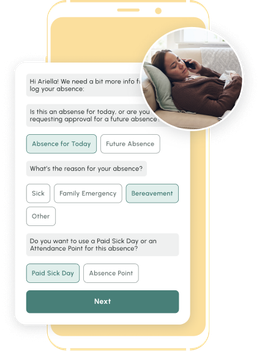
No one wants to talk to their boss or a 1-800 stranger to call off. Text changes everything - Reducing No Call No Shows.
Impact of absenteeism on production: the operational chain reaction
Absenteeism affects production because manufacturing systems are tightly coupled. When one person is missing in the wrong place, the plant does not just lose one person’s labor, it loses flow, and the impact of absenteeism on manufacturing productivity can compound quickly through reduced output, higher costs, and lower morale.
Start at the constraint operation, where a missing operator or technician limits the entire value stream. The team rebalances the line, work-in-process accumulates, and micro-stoppages increase as material and labor no longer arrive in the right sequence.
Next, cycle times stretch, and hourly targets are missed, which pushes supervisors toward short-term fixes. Coverage typically comes from overtime, temp labor, or pulling people from other lines, and each option adds friction through learning curves, travel time, and extra coordination.
Quality risk rises when less experienced coverage is used or when the team rushes to recover. Safety exposure rises as well, because fatigue and unfamiliar tasks make it harder to follow critical steps consistently.
The same absence rate can produce very different results depending on which roles are absent. As a neutral benchmark for context, the 2023 absence rate for employed full-time wage and salary workers in manufacturing was 2.8%, but the operational impact in any specific plant depends heavily on constraints and skill coverage.
Where the losses show up: throughput, quality, and on-time delivery
Throughput losses show up first in units per hour, schedule attainment, and line rate. If the team is constantly rebalancing to cover gaps, the line can appear busy while still failing to hit planned output.
Quality losses typically appear as higher scrap, more rework, lower first-pass yield, and more customer complaints. These are often second-order effects that lag the staffing disruption by hours or days, which is why plants can miss the true cause.
Delivery losses show up in OTIF, expedites, premium freight, and missed dock appointments. Once the schedule becomes unstable, planners and supervisors spend more time rescheduling than improving flow.
Labor impacts show up in overtime hours used for coverage, temp utilization, added supervision overhead, and increased training time. In January 2026, manufacturing overtime was 2.9 hours and the average manufacturing workweek was 40.1 hours, which supports the reality that many plants run near capacity and use overtime as a pressure valve.
Why manufacturing is more vulnerable to attendance variability than other sectors
Manufacturing roles are often skill-specific, and some require certification, documented qualification, or task sign-off. When a certified forklift operator, maintenance tech, or quality technician is absent, the plant may be constrained by compliance and safety requirements, not just headcount.
Coverage ratios are also more rigid. A line may require a minimum number of operators, a certain level of maintenance coverage, and specific quality checks per shift, and those requirements do not shrink when attendance dips.
Constraint management magnifies the impact. One bottleneck can cap output for the entire plant, so an absence at the constraint behaves like a hard stop even if other areas are fully staffed.
Changeovers raise the stakes further. Losing an experienced setup person can extend transition time, increase scrap at startup, and push the plant into a more reactive schedule.
Safety and compliance requirements add another layer of vulnerability. Lockout/tagout, PPE, powered industrial truck operation, and task-specific training can make it impossible to “just plug someone in” without taking on unacceptable risk.
The business cost case: translating attendance into dollars without guessing
Attendance volatility becomes easier to prioritize when it is translated into cost categories leaders already manage. The goal is not to guess at a single “cost per absence,” but to consistently capture the real costs your plant incurs when coverage breaks down, using both internal data and broader employee absenteeism statistics and trends as context.
Start with a checklist of cost categories and measure what you can directly. Direct labor replacement includes overtime premiums, shift differentials, and call-in pay when applicable, supported by a clear employee absenteeism rate calculation so leaders are working from a shared baseline.
Indirect labor costs include supervisor time spent rescheduling, HR time, and training time for coverage and requalification. Production loss includes missed output, increased cycle time, downtime created by imbalance, and the ripple effects of rescheduling.
Quality loss includes scrap, rework, returns, warranty, and containment activities. Delivery loss includes expedites, premium freight, penalties, and lost orders, and safety and workers’ comp exposure can be tracked as a category even when you are not assigning a dollar value.
For leadership context, productivity losses related to personal and family health problems have been estimated at $1,685 per employee per year, or $225.8 billion annually, which helps frame why attendance stability matters financially.
To avoid guessing, use your own plant numbers and build confidence over time. Collect four weeks of data, then expand to thirteen weeks, then fifty-two weeks, and segment by department, line, shift, and reason codes if you have them.
The Costly Impact of Absenteeism on Manufacturing Operations
Learn how chronic, unplanned absenteeism is a costly impediment to manufacturing productivity and efficiency, and how you can reduce absenteeism.
A simple measurement model (writer must include formulas)
Use consistent definitions so operations, HR, and CI leaders are discussing the same problem. Keep calculations simple, repeatable, and easy to segment, and consider tools like an absence rate percentage calculator for frontline teams to standardize how plants compute and share these metrics.
- Absence rate (headcount-based) = absences / scheduled employees.
- Lost worktime rate (hours-based) = absent hours / scheduled hours.
- Coverage rate = covered shifts / absent shifts.
- Overtime coverage share = overtime hours used for coverage / total coverage hours.
At minimum, segment results by shift and by role family, such as operators, material handling, maintenance, and quality. Also, segment by constraint versus non-constraint work centers, because a small change at the constraint often creates a large change in output.
If you align to BLS absence concepts for internal definitions, keep the mapping descriptive and ensure your team agrees on what counts as an absence versus other paid or unpaid time off.
When you operationalize these metrics, make sure the “numerator” data is easy for supervisors to trust. Some teams use solutions like TeamSense to help track employee absences in real time and to standardize and timestamp call-outs and shift disruptions as they occur, but the key is that whatever system you use is consistent enough to segment by shift, role family, and constraint.
Common root causes of unpredictable attendance in manufacturing
Root causes are rarely “one thing,” and plants get better results when they separate operational contributors from people and system contributors. The point is to identify fixable drivers, not to assign blame.
Operational contributors often include overtime fatigue and shift scheduling patterns that do not allow enough rest. Job design and ergonomics can also matter, because physically demanding work increases the difficulty of maintaining reliable attendance over time, which is why plants benefit from structured strategies to reduce workplace absenteeism.
Transportation and childcare friction commonly hits off-shifts harder. When the plant’s schedule does not match the community’s schedule, attendance becomes more sensitive to disruptions outside the plant.
People and system contributors often start with policy clarity and consistency. If expectations are unclear or enforcement feels uneven across teams, employees are more likely to disengage, and supervisors are more likely to negotiate exceptions shift by shift, instead of following a defined approach to address excessive absenteeism in the workplace.
Supervisory practices and perceived fairness matter because they shape whether employees feel safe raising issues early. Training gaps can also drive call-ins when coverage feels stressful, especially for roles where mistakes are visible and consequences are immediate.
A practical way to triage causes is to separate “can’t show” from “won’t show” from “shouldn’t show.” Illness and contagion policies belong in the “shouldn’t show” category, because the plant is better off preventing broader spread and bigger staffing shocks later.
Mitigation playbook: how to reduce production risk when absences happen
Plants do not need perfect attendance to protect throughput. They need controls that reduce the production penalty per absence, especially at constraints and high-skill stations, alongside broader strategies to improve employee attendance so reliability improves over time.
Cross-training supported by a skills matrix is the fastest way to reduce single-point-of-failure roles. Prioritize depth at constraint operations first, then expand coverage outward to feeder processes and support roles, while also revisiting policies and systems using manufacturing-specific strategies to reduce absenteeism.
Standard work and job aids help coverage perform closer to standard when people rotate. This reduces variation in cycle time and quality when less experienced employees step into a role.
Daily tier meetings should include a staffing-risk agenda: identify the top three staffing risks and the top three countermeasures for the day. When staffing risk is reviewed like material risk and quality risk, the plant reacts earlier and with less disruption.
Flexible staffing pools can provide a buffer without permanently overstaffing every line. Options include floaters, retiree or on-call pools when feasible, and pre-qualified temp agencies with a defined onboarding flow and quality gating steps, supported by broader efforts to tackle the causes, costs, and solutions for workplace absenteeism.
Smart scheduling can also reduce chaos without stereotyping. Enable voluntary shift swaps with clear guardrails, and use attendance-aware scheduling for known high-risk days based on your own historical patterns, within a framework that directly addresses excessive absenteeism in the workplace.
Policy and program options should stay practical and plant-ready. Tighten employee call-in procedures for unplanned absences, apply return-to-work expectations consistently, and recognize reliability in ways that employees perceive as fair and achievable. Where plants struggle with “phone tag” during the call-in window, platforms like TeamSense are sometimes used to replace traditional employee call-off hotlines with text-based systems to make absence reporting more consistent and to reduce delays in coverage decisions, but the procedural clarity (who to notify, by when, and what happens next) is still the control that protects the shift.
Stabilizing staffing when turnover and quits are also in play
It is critical to separate an “attendance problem” from a “capacity problem.” Chronic understaffing forces overtime, overtime drives fatigue, and fatigue makes both absences and turnover more likely.
Use early warning signals that operations can see without waiting for quarterly reviews. Rising quits, rising overtime coverage share, an increasing number of new-to-role operators on critical stations, and spikes in data from an automated employee call-in system are all signs that staffing stability is degrading.
Actions should focus on removing avoidable strain and shortening the learning curve. Reduce mandatory overtime where possible, improve onboarding speed-to-competency for key stations, and coach supervisors on practices that reduce preventable churn.
What to track weekly: an attendance and production risk dashboard
Weekly tracking turns attendance from a daily fire drill into an improvement loop. The dashboard should connect staffing variation to the KPIs that leaders already run the business on.
Required weekly metrics include absence rate by shift and lost worktime rate by department. Track overtime hours used for coverage, because it shows both the cost of coverage and the strain being placed on the workforce.
Add schedule attainment to quantify whether staffing issues are breaking the plan. Include first-pass yield to catch quality drift that can follow aggressive coverage moves.
Near misses or safety observations should be included if the plant already tracks them internally. Avoid external benchmarks here, and focus on whether staffing volatility is changing risk signals in your own operation.
Weekly review questions should be consistent and decision-oriented. Where did absences hit constraints, how did we cover and what did it cost, and which countermeasure will we test next week?
To reduce admin load, some teams use tools such as TeamSense or other attendance tracking solutions beyond traditional apps to help roll up absence and coverage patterns so the weekly review can focus more on decisions than data cleanup but the dashboard is still valuable even if it is built from simple exports and disciplined weekly ownership.
FAQs
-
Plants that struggle with manual tracking often see avoidable disruption from late call-ins and no-shows; moving to automated attendance systems that reduce no call no show incidents can lower the operational impact by giving supervisors earlier, more reliable information.
Absenteeism affects production by breaking flow at the points where staffing and cycle time are tightly linked. The biggest impact usually occurs when the missing role is at a constraint, requires qualifications, or is critical to changeovers, material movement, maintenance response, or quality checks.
-
A “good” rate depends on your constraints and skill coverage, because the same rate can be manageable in a flexible area and destructive at a bottleneck. For neutral context, the 2023 absence rate for employed full-time wage and salary workers in manufacturing was 2.8%, but plants should benchmark themselves by shift and constraint roles, not only by a single plant-wide number. (Source: U.S. Bureau of Labor Statistics, https://www.bls.gov/cps/data/aa2023/cpsaat47.htm)
-
Use at least two views: a headcount-based absence rate and an hours-based lost worktime rate. Then add a coverage rate and overtime coverage share so you can see not only how often absences occur, but how the plant is paying for coverage and where the operational penalty is coming from.
-
Absenteeism is about day-to-day presence versus schedule. Turnover is about people leaving roles or the company, which changes the skill base and increases training and supervision demand, and it can worsen attendance problems by increasing overtime and stress.
-
Start by reducing avoidable strain, especially repeated mandatory overtime and inconsistent supervisory practices. Make policies clear and predictable, invest in cross-training so coverage feels supported, and recognize reliability in a way that employees view as fair and attainable.
Unpredictable attendance is an operational risk because it increases variation at exactly the points where manufacturing systems are least tolerant of variation. The impact of absenteeism on production is primarily a constraint and variability problem, not a simple headcount problem.
Resilience comes from reducing the penalty per absence through skills depth at constraints, simple standard work, and a repeatable staffing-risk cadence. Build a baseline, track how you cover and what it costs, and use that visibility to prioritize cross-training and staffing buffers where they protect throughput the most.
About the Author

Sheila Stafford, CEO & Co-Founder, TeamSense | Former Manufacturing Leader at GM, Whirlpool, and Fluke
Sheila Stafford is CEO and co-founder of TeamSense. Before launching TeamSense in 2020, she built her career inside manufacturing, starting as a manufacturing engineer at General Motors and later leading teams and product work at Whirlpool. She also served as a general manager at Fluke, where she led the Industrial Imaging business.
That background shapes how she writes about manufacturing operations, absenteeism, frontline communication, and workforce visibility. Stafford has worked close to plant operations, supply chain, product development, and the day-to-day realities of frontline teams. At TeamSense, she works directly with manufacturers on attendance and communication challenges, and her work has also appeared on Forbes Business Council.
