

Fix the root cause of No-Call No-Show with help from TeamSense
Table of Contents
- Define the real problem: monthly attendance reports are on the wrong time scale
- What a monthly report can show accurately
- What a monthly report hides in manufacturing operations
- How daily unplanned absences become business risk: the operational chain reaction
- Daily staffing gaps show up as lost planned production time
- The visibility gap: why you cannot manage attendance data you only see monthly
- The core attendance reporting problems in the manufacturing industry
- Addressing the root causes of absenteeism
- Promoting employee engagement to reduce daily absence risk
- Employee well-being and its impact on attendance
- Reporting granularity that operations actually needs
- A better approach: daily attendance risk reporting that triggers action
- Recommended daily report views (templates the writer must describe)
- Coverage playbook: what to do when the report shows risk
- KPIs to pair with attendance to prove impact (without hiding risk)
- How to avoid "metric theater" with monthly averages
- Implementation checklist for manufacturing teams
- Final Thoughts
You know the month-end attendance report. It says absenteeism was "fine," maybe even better than last month.
Then you look back at the month and remember the reality. Two Mondays where the line started late. A Friday night where you ran short and burned overtime. A day when one certified operator was out, and the whole cell got weird.
That is the gap. Monthly summaries are real data, but they are the wrong time scale for how manufacturing actually runs.
Define the real problem: monthly attendance reports are on the wrong time scale
A monthly absence report usually shows totals and averages. Absence percentage rate for the month, occurrences by department, and maybe a ranked list of repeat offenders. It is clean, organized, and... late.
Daily staffing risk is different. It is a shift-by-shift view of whether you have the right number of people, in the right roles, at the right time to hit today’s plan. In manufacturing, the average matters less than the bad days, because you cannot “average out” a missed start or a bottlenecked role.
It also helps to remember absences are not rare in the first place. BLS reports a 2025 absence rate of 2.9% for full-time wage and salary workers in manufacturing, and a 2025 lost worktime rate of 1.6%.
That does not mean 2.9% of your people will no-show today. It just tells you absences are a normal, ongoing condition. The operational problem is that they do not show up evenly across days and roles. Effective attendance tracking and access to real time data are essential for managing daily staffing risk, as they allow managers to monitor attendance instantly and respond to absences as they occur. Some teams use solutions like TeamSense to capture callouts the moment they happen and surface that data at the shift level rather than waiting for month-end rollups giving operations a view that actually matches the pace of the decisions being made.
What a monthly report can show accurately
Monthly reporting is still useful when the question is month-sized.
It can show whether absence patterns are trending up or down over time. Monitoring absence data trends helps identify underlying issues, support compliance requirements, and enables proactive workforce management. Attendance metrics such as the absence rate percentage can also support policy audits, like total occurrences by person or department.
It is also useful for longer-range staffing conversations. If you are trying to decide whether a department is structurally understaffed, month-level data helps. The financial impact of absenteeism is significant, according to the CDC; absenteeism results in an estimated $225.8 billion annual loss in productivity across the United States.
And for HR process tracking, monthly is often the right view. Things like whether attendance cases are being documented consistently tend to move more slowly than the shop floor.
What a monthly report hides in manufacturing operations
Monthly rollups hide spike days. Two ugly days can wreck output, then the rest of the month looks normal, and the average settles down. Manufacturing absenteeism can have a significant impact on operational efficiency and overall business performance, affecting productivity, safety, and morale across the plant, as detailed in the impact of absenteeism on manufacturing productivity.
They also hide role bottlenecks. Losing one person is not always “minus one headcount.” If that person is the only one certified on a station, the constraint is not headcount; it is capability. The impact of absenteeism here can include reduced output, missed deadlines, and increased customer complaints due to quality issues or delayed shipments.
Monthly reporting also smooths over short-notice callouts. The biggest damage is usually done before the shift even gets traction, when you are scrambling to cover breaks, rebalance the line, and keep a safe crew. Employee absence can also increase costs through overtime pay or hiring temporary workers to fill gaps.
And it hides leading indicators. If the first time you see a problem is on the 3rd of the next month, you missed your chance to manage it while it was happening.
Absenteeism can also create a negative work environment, where present employees may develop resentment towards frequently absent colleagues, leading to decreased morale.
The Costly Impact of Absenteeism on Manufacturing Operations
Learn how chronic, unplanned absenteeism is a costly impediment to manufacturing productivity and efficiency, and how you can reduce absenteeism.
How daily unplanned absences become business risk: the operational chain reaction
A daily absence is not just an attendance issue. It is a chain reaction that hits throughput, downtime exposure, overtime, and quality, creating exactly the kind of operational risk from unpredictable attendance that plants struggle to control.
It usually starts with the basics. Understaffing slows changeovers, pushes startups later, and turns the first hour into triage instead of production.
Frequent absenteeism and excessive unplanned absences can hinder effective communication and collaboration within teams, leading to missed deadlines and reduced work quality.
Then line balance breaks down. One missing operator forces a re-shuffle, and now experienced people are covering unfamiliar work, or you are running a cell below its minimum crew, eroding the manufacturing flexibility you need to respond to changing demand.
Overtime becomes the recovery lever. It gets the plan back on track sometimes, but it also stacks fatigue onto a process that is already under stress. However, relying on overtime to cover for absent employees increases overtime costs, adding significant financial pressure to manufacturing operations and underscoring the need for structured overtime management strategies in manufacturing.
Quality risk shows up next. When you plug a gap with less experienced coverage, you do not just risk scrap, you risk missing the small signals that prevent bigger problems. Effective absence reporting systems are essential to fill gaps quickly and maintain productivity, and modern automated attendance systems make it easier to capture accurate data and route it to the right people in real time.
Unplanned downtime is where this gets expensive fast. In a Fluke Reliability survey release, Fluke reports that 61% of manufacturers suffered unplanned downtime in the past year. (Source: Fluke Reliability, )
The same survey release reports downtime costs manufacturers up to $852 million per week, and cites an average cost of $1.7M per hour.
You do not need to claim absences cause all downtime to see the risk. Staffing gaps remove margin. When the process is tight and coverage is thin, small disruptions turn into longer stops.
Unplanned absenteeism can cost companies an average of $3,600 per year for each hourly worker and $2,650 annually for salaried employees, so using tools designed to reduce overtime and regain control of labor costs becomes a critical lever for protecting margins.
Daily staffing gaps show up as lost planned production time
Planned production time is the time you intended to run. If you are scheduled to run and you cannot run, that time is gone.
Absences occur unexpectedly in manufacturing environments, so effective shift management is required to minimize disruptions and ensure coverage for open shifts, which is why many plants are moving from traditional call-off hotlines to modern text-based absence reporting systems.
That is why staffing is not just an HR input. It is a prerequisite for using the time you already scheduled.
This is also why daily absences show up in OEE style thinking, even if you do not talk about it that way on the floor. OEE.com defines Availability as the ratio of Run Time to Planned Production Time.
When you are not running when you planned to run, Availability takes the hit. And staffing is one of the easiest ways to lose runtime without a single piece of equipment breaking. In manufacturing, absenteeism can result in reduced output as remaining workers may rush or skip steps to meet production targets.
The visibility gap: why you cannot manage attendance data you only see monthly
Monthly reports are lagging indicators. They tell you what happened after you already paid for it in overtime, missed output, and stress.
Manufacturing decisions have tight windows. Pre-shift is where you still have options. Shift start is where your options shrink. First-hour escalation is where you decide whether you are protecting the schedule or just trying to survive the day.
If you do not see callouts and coverage risk until the month closes, you are basically choosing the highest-cost response. Last-minute coverage, poor reassignments, and reactive schedule changes become the default. Automated alerts for last minute call ins are essential to ensure supervisors are informed in real time and can respond quickly to unexpected absences, especially when paired with automated attendance tools that reduce no call no show incidents.
Implementing an efficient notification system is vital for managing employee absenteeism effectively.
The core attendance reporting problems in the manufacturing industry
Most plants are not failing at “tracking attendance.” They are failing at getting attendance data into an operational shape that helps run the day. Accurate attendance reporting and robust absence reporting systems are critical in manufacturing to ensure real-time visibility, minimize disruptions, and maintain compliance with labor regulations.
Data latency is the first problem. Callouts get logged late, or they sit in someone’s inbox, and by the time the system is updated the supervisor already made coverage decisions. Platforms like TeamSense are sometimes used to reduce this lag by routing callouts through text, so absence information is timestamped and visible before the next coverage decision gets made not hours later. Shifting away from the traditional “call a manager” model toward text-based call-off management ensures callouts are captured consistently and supervisors see issues before the shift starts. Automated absence management tools now allow employees to report absences via app or SMS, triggering immediate notifications to managers and streamlining the absence reporting process.
Fragmented systems make it worse. HR has one view, time clocks have another, scheduling lives somewhere else, and the skills matrix is a spreadsheet that may or may not be current. Effective compliance management is essential to ensure all attendance and shift scheduling systems adhere to labor laws and regulatory standards. Consulting legal counsel is recommended to review leave policies and maintain proper records, reducing the risk of non-compliance.
Granularity is another killer. Department-level rollups do not help when the real pain is one line, one cell, one shift, and one role.
Then there is the planned versus unplanned gap. Operations needs to know who is not showing up today, not who is out on a planned leave you already accounted for.
Definitions are often inconsistent too. Absence, tardy, partial shift, and early out all create different kinds of coverage problems, but they get blended together.
And finally, manual spreadsheets create version problems. Two people update two copies, numbers do not match, and nobody trusts what they are looking at. Human error in manual processes can lead to scheduling mistakes, miscommunication, and inaccurate records. Relying on paper sign-in sheets or traditional punch cards increases the risk of buddy punching, where employees clock in for others, causing payroll inaccuracies. Implementing biometric systems like fingerprint or facial recognition, geofencing technology to ensure employees clock in only at designated locations, and mobile or SMS-based solutions for clocking in/out can significantly reduce these risks and improve data accuracy.
Attendance reporting systems designed for manufacturing environments leverage biometric verification, geofencing, real-time alerts, and compliance tracking to address these challenges. Evaluating the best absence management systems and software helps ensure the tools you choose align with both operational and compliance needs. Poor attendance tracking can result in legal penalties and labor law violations due to inaccurate recording of required breaks and overtime.
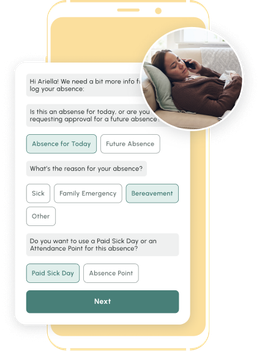
No one wants to talk to their boss or a 1-800 stranger to call off. Text changes everything - Reducing No Call No Shows.
Addressing the root causes of absenteeism
Reducing unplanned absences starts with understanding why they happen in the first place. In the manufacturing industry, employee absenteeism can be triggered by a range of root causes illness, family emergencies, transportation breakdowns, or even workplace stress. If these underlying issues go unaddressed, lost productivity and operational disruptions become the norm, not the exception.
Effective absence management means looking beyond the numbers and digging into attendance data to spot patterns and trends. Time and attendance software can help identify spikes in unplanned absences, flag recurring issues, and provide the insights needed to take action, which is difficult to do with manual spreadsheets compared to modern absence tracking systems. For example, if data shows a cluster of absences on certain shifts or roles, it may point to workload imbalances or morale problems.
Addressing these root causes requires a multi-pronged approach. Wellness programs can help employees manage their health and reduce sick days. Flexible work schedules and support for work-life balance can minimize disruptions caused by family or personal emergencies. Career development opportunities show employees they have a future with the company, which can improve employee morale and reduce the temptation to call out unexpectedly, especially when supported by updated attendance policies and modern reporting methods.
By tackling the root causes of absenteeism, manufacturers can reduce the frequency of unplanned absences, minimize disruptions, and boost overall operational efficiency. The result is a more reliable workforce, better attendance, and a healthier bottom line.
Promoting employee engagement to reduce daily absence risk
Employee engagement is a powerful lever for reducing daily absence risk in the manufacturing industry. When employees feel connected to their work and valued by their organization, they are far more likely to maintain consistent attendance and contribute to a stable operation.
Building engagement starts with recognition acknowledging good attendance and strong performance. Recognition programs, whether formal or informal, reinforce positive attendance trends and show employees that their efforts matter. Career development opportunities also play a key role, giving employees a sense of progress and investment in their future with the company.
Open communication is another cornerstone of engagement. When employees feel heard and can share concerns or suggestions, trust grows, and issues that might lead to unplanned absences can be addressed early. Regular employee engagement surveys can help identify pain points and track the effectiveness of engagement strategies over time.
The benefits of strong employee engagement go beyond attendance. Engaged employees are more productive, deliver higher quality work, and are less likely to leave reducing turnover and the associated costs. This translates into improved operational efficiency, better customer satisfaction, and stronger business performance overall.
By making employee engagement a priority, manufacturers can reduce the risk of unplanned absences, improve attendance, and create a workplace where people want to show up and do their best every day.
Employee well-being and its impact on attendance
Employee well-being is directly linked to attendance and productivity in the manufacturing industry. When employees are physically healthy and mentally supported, they are more likely to have good attendance and contribute positively to operational efficiency. On the other hand, when well-being is neglected, issues like mental health challenges, chronic illness, or burnout can lead to increased absenteeism and lost productivity.
Supporting employee well-being starts with proactive wellness programs that encourage healthy habits and provide resources for managing stress and illness. Access to mental health support, whether through counseling, employee assistance programs, or simply fostering a supportive environment, can make a significant difference in reducing unplanned absences.
Flexible work schedules can also help employees balance work and personal responsibilities, making it easier to manage health appointments or family needs without resorting to unscheduled absences. By prioritizing employee well-being, manufacturers not only reduce the risk of absenteeism but also create a more positive and resilient workplace culture.
The impact is far-reaching: improved attendance trends, lower labor costs, and reduced administrative burden from managing frequent callouts. A healthy, engaged workforce is less likely to disrupt production schedules, leading to higher customer satisfaction and smoother operations. Ultimately, investing in employee well-being is not just good for people, it’s essential for minimizing disruptions, managing employee absenteeism, and driving overall operational efficiency in the manufacturing environment.
Reporting granularity that operations actually needs
If the goal is daily staffing stability, the reporting has to match how the floor is managed.
Time grain should be daily and shift-level, with updates when callouts and early outs happen. “End of day” is often too late. Features like shift differentials and shift swapping in attendance reporting systems can further improve operational flexibility by allowing for accurate pay adjustments and easier shift exchanges.
Org grain should match where staffing decisions happen. Plant is useful, but value stream, building, and line or cell is where leaders can actually act.
Role grain matters as much as headcount. Job, skill, certification, and critical roles need to be visible, because one uncovered certification can be the real constraint. When selecting an attendance reporting system, ensure it is tailored to the specific needs of your manufacturing operation for optimal results.
Absence type should be clear enough to support action. At minimum, planned versus unplanned. If your plant uses excused versus unexcused, that can be layered in, but it should not slow down operational visibility.
Attendance reporting systems can also integrate with payroll software to streamline management, and many support shift scheduling, overtime calculation, and compliance management to reduce administrative burdens.
A better approach: daily attendance risk reporting that triggers action
A daily absence risk report is not a bigger monthly report. It is a short operational view that tells you where you are exposed today and tomorrow
A shift coverage dashboard is the live version of that. It connects schedule, actual presence, and role coverage, so you can see risk before it becomes downtime. Tools such as TeamSense can serve as one input into that kind of dashboard, standardizing how callouts are logged and making the data available to supervisors without requiring manual aggregation, though the same logic applies to any system that gets consistent, timestamped absence data in front of the right people quickly. Real-time data and real-time attendance insights are crucial for predicting workforce gaps and enabling managers to respond proactively.
At a minimum, it needs a few fields that everyone agrees on. Scheduled headcount, actual present, callouts, open positions, and critical roles uncovered.
Then you set thresholds tied to real constraints. Minimum crew for a line. A must-cover certification. Break coverage rules. If a threshold is crossed, the report should call it out with automated alerts and overtime alerts to notify supervisors immediately of staffing issues or potential compliance risks.
Keep it exception-based. You do not need a supervisor scrolling through 18 green lines. You need a short list of reds and yellows with enough detail to act.
Advanced technology solutions for attendance reporting can also include mobile apps for shift management and automated absence reporting tools, further streamlining the process.

Recommended daily report views (templates the writer must describe)
Start with a pre-shift risk snapshot for the next shift. It should show scheduled versus confirmed, open slots, and any critical roles that are currently uncovered. Effective attendance tracking and real-time monitoring of employee attendance are essential here to ensure all positions are filled and to maintain operational efficiency.
Next is start-of-shift actuals versus scheduled. This is where you catch no-shows fast and stop guessing.
You also need mid-shift changes. Early outs, late arrivals, additional callouts, and reassignments. If it changed the plan, it should show up.
A heatmap by line and role makes patterns obvious. Leaders should be able to see, in one glance, where gaps are concentrated.
Finally, include a “top drivers” list. Not a motivational chart, a practical list of the lines, shifts, and days of week where unplanned absence keeps creating the same coverage mess.
Additionally, using digital logs for mustering provides real-time data on employee presence during emergencies, which is critical for safety and compliance.
Coverage playbook: what to do when the report shows risk
The report is worthless if it does not change decisions. You need a simple playbook that matches how the plant actually runs.
First move is rebalancing within the shift. Use floaters, move people to protect the constraint, and adjust staffing where it protects output. Filling gaps quickly is crucial to maintain productivity and minimize disruptions caused by unplanned absences, and strong shift coverage planning in manufacturing gives supervisors a clear playbook for those moves.
Next is calling in trained backups, using on-call lists, and using people who are already approved to cover. Do not burn time negotiating coverage while the line sits.
If the same role keeps showing up as uncovered, treat it like a recurring constraint. Build a cross-training plan that targets that role first, not a random rotation plan.
If coverage is not possible, adjust the production plan intentionally. Sequence work to match available skills, push noncritical runs, and communicate the tradeoffs early.
Lock in escalation rules and a communication cadence. Who gets called, when, and what decisions they can make. Nobody should be improvising at 5:40 a.m.
To address absenteeism effectively, engage with employees to understand their motivations for absences and work together to identify solutions.
KPIs to pair with attendance to prove impact (without hiding risk)
If you want to show impact without falling back into monthly averages, pair attendance with operational KPIs that move daily.
At a daily level, track schedule attainment, overtime hours, downtime minutes during planned production time, and first pass yield. Use attendance tracking to monitor real-time attendance and identify absence trends, so you can connect a staffing hit to the day it happened and spot emerging patterns.
At a weekly level, track recurring uncovered critical roles and cross-training coverage progress. Weekly is where patterns become clear without waiting for month end, and analyzing absence trends helps uncover underlying issues and compliance requirements.
At a monthly level, you can still review attendance patterns and policy adherence. Just do not pretend that a clean monthly number means the floor was stable.
Real-time attendance insights from attendance reporting systems help predict workforce gaps and enable strategic adjustments before they impact production.
How to avoid "metric theater" with monthly averages
Monthly averages let you “win” on paper while the floor still suffers. You can improve the average by cleaning up documentation, while spike days keep getting worse.
Bad incentives make it worse. People delay entry, reclassify events, or push updates to the end of the week, and the monthly number looks calmer than the real-time experience.
To keep it honest, track distribution, not just averages. Things like the percent of shifts below minimum staffing, and the count of critical-role misses, keep the focus on operational risk without needing fancy math. Analyzing historical data and historical patterns, such as past attendance records and shift coverage, helps identify recurring attendance reporting problems and supports more accurate scheduling.
Additionally, engaging with employees through surveys can help uncover the reasons behind absenteeism and inform better attendance management strategies.
Implementation checklist for manufacturing teams
Start by aligning definitions. What counts as an absence, a tardy, a partial shift, and an early out, and when it gets timestamped. When mapping these definitions and data flows, prioritize compliance management to ensure adherence to labor laws and regulatory standards. Consult legal counsel or HR experts to review and update leave policies and recordkeeping practices.
Then map critical roles and minimum staffing constraints by line and cell. If you do not define what “unsafe to run” looks like, you cannot alert on it.
Establish the data flow from timekeeping to a daily dashboard. The goal is to cut latency so the view matches the decisions being made. Some teams use platforms like TeamSense to handle this step, routing callout data through text so it reaches the supervisor-facing view quickly, but any consistent, low-latency data path will work as long as the information gets to the right person in time to act. Automating payroll integration by syncing attendance data with payroll software at this stage minimizes wage disputes and ensures compliance with labor laws.
Set alert thresholds and assign escalation owners. If the alert fires, it should be obvious who owns the next move.
Pilot on one value stream, then scale plant-wide. Pick an area where the pain is real, so you get adoption fast.
Finally, set governance that matches the work. A quick daily standup review for today’s risk, plus a weekly continuous improvement review to fix recurring coverage problems. Incentivizing good attendance can encourage employees to be more punctual and engaged. Additionally, offering flexible work schedules can improve employee retention and reduce absenteeism.
Final Thoughts
Monthly attendance reporting is not the full picture. It is just not enough when you are trying to manage absenteeism reporting risk on the floor, where the real cost shows up shift by shift.
The main attendance reporting problems manufacturing teams run into are time scale and actionability. Monthly averages hide spike days, critical-role misses, and last-minute callouts that actually drive downtime, overtime, and quality exposure.
Daily and shift-level visibility prevents surprises. It gives supervisors time to rebalance labor, call in trained backups, adjust the plan on purpose, and stop paying for the same staffing gap over and over.
If your current attendance reporting only tells you what happened after the month closes, build a daily attendance risk view, define your critical roles, and put a coverage playbook behind it. That is where the operational wins come from.
About the Author

Sheila Stafford, CEO & Co-Founder, TeamSense | Former Manufacturing Leader at GM, Whirlpool, and Fluke
Sheila Stafford is CEO and co-founder of TeamSense. Before launching TeamSense in 2020, she built her career inside manufacturing, starting as a manufacturing engineer at General Motors and later leading teams and product work at Whirlpool. She also served as a general manager at Fluke, where she led the Industrial Imaging business.
That background shapes how she writes about manufacturing operations, absenteeism, frontline communication, and workforce visibility. Stafford has worked close to plant operations, supply chain, product development, and the day-to-day realities of frontline teams. At TeamSense, she works directly with manufacturers on attendance and communication challenges, and her work has also appeared on Forbes Business Council.
