

Fix the root cause of No-Call No-Show with help from TeamSense
Table of Contents
- Line Productivity Loss and Why One Absence Can Trigger It
- The Chain Reaction: Where Productivity Goes When One Person Is Missing
- Where the Loss Shows Up in Your Key Performance Indicators (And What to Track)
- The Staffing Productivity Impact: Hidden Costs Beyond Missed Units
- Employee Engagement: The Human Factor in Absence Recovery
- Prevention and Mitigation Playbook (What to Do Before, During, and After an Absence)
- Final Thoughts
Everybody has seen the same movie. You start the shift short one operator, you think you can “just cover it,” and by mid-morning the line is behind, downtime is creeping up, and the good parts count is not where it needs to be.
This is not an edge case in manufacturing. The real problem is that a production line is a system. One missing person does not just remove one set of hands. It can change the constraint, throw off balance, and create quality and downtime losses that take the rest of the shift to dig out of.
Line Productivity Loss and Why One Absence Can Trigger It
On the floor, “line productivity” usually means a few simple outcomes. Are we making units per hour at the pace the board says we should? Are we getting the labor productivity we planned for? Are we hitting schedule attainment by the end of the shift?
A single absence can punch a hole in all three at once. The missing operator often sits on a station that has tribal knowledge, a certification requirement, or a task that quietly sets the rhythm for everything else.
The reason is basic line behavior. Stations are connected, material flows between them, and the slowest effective step becomes the pace setter. When one person is gone, that pace setter can shift in an instant, even if the rest of the line is fully staffed.
Absences are common enough that it makes sense to design for them. To address this, optimizing staffing levels for balancing efficiency is crucial not only to maintain productivity but also to support employee well-being and prevent fatigue or safety issues. Some teams use solutions like TeamSense to capture call-outs at the moment they happen, giving supervisors a cleaner picture of which roles are uncovered before the shift begins rather than after coverage decisions are already made, instead of relying on monthly absence reports that hide day-to-day staffing risk.
Improving production efficiency in this way is essential for the business to stay competitive and achieve organizational success in today’s marketplace.
The Costly Impact of Absenteeism on Manufacturing Operations
Learn how chronic, unplanned absenteeism is a costly impediment to manufacturing productivity and efficiency, and how you can reduce absenteeism.
The Chain Reaction: Where Productivity Goes When One Person Is Missing
The first hour after an absence is when the damage usually starts. Not because people stop caring, but because the line loses its normal pattern and everyone starts making small adjustments that stack up.
Here are the primary mechanisms that turn one missing operator into measurable productivity loss:
- Bottleneck shift: the absent person’s station becomes the constraint
- Line imbalance: upstream WIP piles up, downstream starvation occurs
- More stops and micro-stops: waiting on material, checks, approvals, changeovers
- Material shortages: lack of necessary materials can cause line stoppages and disrupt production continuity
- Slower cycle times: less experienced coverage, added walking, added handoffs
- Quality loss: missed checks, rushed work, more rework and scrap
- Changeover disruption: fewer hands for standardized changeover tasks
- Maintenance and troubleshooting delays: fewer people available to respond
Stoppages often involve human errors, which can range from simple operational mistakes to more complex issues like operator absenteeism or persistent skills gaps, and unplanned downtime in manufacturing can quickly become one of the most expensive consequences of those gaps.
Each one ties to something you can see. Bottleneck shift and imbalance show up as reduced units per hour. Stops and micro-stops show up as downtime minutes and OEE Availability loss. Slower cycle times show up as OEE Performance loss, especially if the line stays “running” but at a lower pace. Equipment downtime, especially from aging machinery, is a leading cause of efficiency loss and can disrupt operations and delay deliveries. High defect rates force production to stop for rework, wasting resources and time.
Then the secondary mechanisms kick in. Supervisor time gets pulled into staffing triage instead of controlling the process. Cross-coverage gets improvised, which creates training debt that shows up later as slower coverage and more mistakes. Fatigue rises for the team that is still there, which raises error risk even if nobody wants to admit it, which is why unpredictable attendance is such a major operational risk in manufacturing.
Identifying and addressing the root cause of bottlenecks is crucial to improving overall performance in manufacturing lines. Proactive maintenance is often the best defense against unplanned downtime like line stoppages.
If your line is already tight, even short interruptions can be expensive. Fluke reported that more than six in ten manufacturers, 61%, suffered unplanned downtime in the past year in its survey, which is a reminder that “stopping” is a normal risk state for many plants.
Constraint Math Without the Math: Why a 1-Person Loss Can Become a Multi-Station Loss
Think of the pace setter station as the one that everybody else has to match. If it slows down, the whole line slows down, even if every other station is capable of running faster.
Process optimization often involves mapping operations using tools like value stream mapping and stream mapping to identify bottlenecks and standardize workflows. These Lean manufacturing methodologies help systematically pinpoint inefficiencies and support continuous improvement in manufacturing processes.
When utilization is already near capacity, there is no slack to absorb variability. You do not have spare people, spare time, or spare WIP space to “hide” a coverage gap. The line reacts immediately because the system has nowhere to put the disruption.
Short staffing also turns parallel work into sequential work. Two-person lifts become “wait until someone is free.” One operator ends up running two stations, so every task gets a little slower, and every handoff adds a little more walking and waiting. Approvals and checks that used to happen on the fly start queuing up, which creates stop time that looks like bad luck but is really a staffing design issue and highlights why skill coverage matters more than simple headcount in manufacturing.
Where the Loss Shows Up in Your Key Performance Indicators (And What to Track)
If you want to control absence impact, you have to measure it without guessing. The trick is to connect staffing changes to the KPIs that move the same day, not a month later. Leveraging operational data and real-time attendance data provides immediate and accurate insights into your production line performance, allowing you to respond quickly to issues as they arise.
Track these KPIs consistently when you are short:
- Schedule attainment or plan vs actual
- Units per labor hour
- OEE, especially Availability and Performance
- Downtime minutes by reason codes (staffing-related categories)
- First-pass yield, defects per unit, rework hours
- Changeover time vs standard
- Overtime hours and premium labor
Utilizing Manufacturing KPIs provides a data-driven view of production performance and enables actionable insights to optimize responses to line productivity loss in manufacturing, especially when fed by real-time attendance tracking software for hourly employees.
The most important operational rule is reason-code discipline. Give people clean options like “No operator,” “Relief not available,” “Waiting on QA,” and “Training coverage,” and coach teams away from dumping staffing losses into “Other.”
Do a short daily review that compares staffing deltas to KPI deltas. If the line was down one person and Availability dropped, do not let the conversation end at “we were short.” Make it specific: which station became the constraint, what stopped first, and what would have prevented that stop. Digital skills matrices can help teams identify skills gaps and assign training resources as needed to reduce line stoppages. Platforms like TeamSense are sometimes used to reduce data latency in this area, routing call-outs through text so that absence information is already timestamped and available for the daily review rather than reconstructed from memory after the shift.

Leading Indicators That an Absence Will Hurt Output Before It Happens
You can usually spot a bad day in the plan before it becomes a bad day on the floor. The signals are not complicated, but they get ignored when everyone is busy.
Watch for these leading indicators:
- Single-point-of-failure stations (only one trained person)
- High takt adherence with no buffer
- High changeover day
- High defect sensitivity processes
- Special-process steps requiring certification
Use a simple readiness checklist in shift planning. The idea is “at least two trained operators per critical task,” plus a visual skill matrix and a coverage plan by shift.
Cross-training is not just a feel-good concept. Research on cross-training in manufacturing cells frames it as a way to handle fluctuations and support effective operator assignment when conditions change, and strong shift coverage planning in manufacturing turns that cross-training into a practical staffing advantage on the floor.
The Staffing Productivity Impact: Hidden Costs Beyond Missed Units
The missed units matter, but they are not the full bill. The bigger hit often comes from the recovery actions you have to take to get back on plan.
Here are the cost categories that tend to show up after a single absence:
- Downtime cost exposure when the line stops
- Expedited freight and recovery production costs
- Overtime premium pay for catch-up work
- Quality costs: scrap, rework, extra inspections
- Safety risk and incident likelihood
- Customer impact: late shipments, OTIF deterioration
Improving line operating efficiency can help manufacturers reduce costs by optimizing resources and enhancing productivity, which is especially important given rising input costs and competitive pressures, and it often depends on building manufacturing flexibility to respond to changing demand and staffing.
Overtime is a real cost lever, not just a scheduling lever. Under U.S. federal law, unless exempt, overtime pay must be at least 1.5 times the regular rate after 40 hours of work in a seven-day workweek. Thoughtful overtime management strategies in manufacturing are essential to keep those costs under control while still protecting throughput.
Downtime benchmarks vary a lot by plant size, automation level, and product value. Still, they are useful for perspective when teams treat short stops like they are free. Fluke reported an average cost of $1.7M per hour in its downtime survey summary, which should make anybody take “we lost 20 minutes” more seriously.
If you run high-volume, high-capital production, the stakes can be even higher. Siemens reported that in a large automotive plant, an hour of downtime costs $2.3 million per hour.
Unplanned downtime can cost manufacturers up to $5,600 per minute and typically causes a 5–20% drop in annual capacity. Manufacturing productivity loss can create a ripple effect that increases the cost per unit, wastes labor and material, and leads to lost revenue.
Siemens also estimated that the world’s 500 biggest companies lose almost $1.4 trillion annually through unplanned downtime, equivalent to 11% of their revenues. (Source: Siemens,
A Practical Cost Model
You do not need a fancy spreadsheet to estimate impact. You need a consistent template that your plant can plug real numbers into.
Use a variable-only model like this:
- Lost units = (planned rate − actual rate) × affected time
- Labor cost impact = overtime hours × overtime rate premium + idle labor hours × loaded labor rate
- Quality cost impact = scrap units × unit cost + rework hours × loaded labor rate
- Downtime cost impact = downtime hours × cost per hour (site-specific)
Do not grab an “average downtime cost” off the internet and treat it like your plant. If you want to show an example internally, label it as an illustrative scenario and state that the inputs are hypothetical.
Employee Engagement: The Human Factor in Absence Recovery
Look, you can have the best machines and perfect schedules on paper, but when someone calls off at 5:30 AM, it's your people who make or break the shift. I've seen lines shut down because nobody stepped up, and I've seen crews pull together and actually run better than usual. The difference? Whether your team cares about the work.
When people care about what they're doing, they catch problems early. They'll notice that bearing getting loud before it seizes up. They'll spot quality issues before you're shipping bad parts. And when Joe calls in sick again, they'll jump on his machine instead of standing around waiting for someone else to figure it out. It's not rocket science, people who know what they're doing and want to be there just handle things better.
Here's what I've learned: treat people right, and they'll take care of the operation. Give them real training, not just safety videos. Listen when they tell you something's wrong with a machine. Let them go home on time when things are running smoothly. Do that, and you'll have people who stick around and actually know how to run the place. Turnover kills you every time someone leaves; you lose months of knowledge and experience.
Your people also control whether your machines actually run. When they know how to spot problems and fix small stuff before it breaks, your downtime drops fast. When they care about quality, your defect rates go down. When they show up and know their jobs, you're not scrambling to cover shifts or explain to the customer why their order's late.
Want better attendance and fewer headaches? Talk to your people like they're adults. Give them real feedback, not corporate speak. When someone does good work, tell them. Train them properly so they can handle different jobs when you're short-handed. Don't just throw them on a machine and hope for the best. Plants that have moved from manual hotlines to text-based call-off systems that employees actually use often see both attendance visibility and trust improve.
Bottom line: when people don't show up, engaged crews adjust and keep running. When people don't care, one call-off can mess up your whole day. You want a stable operation that hits numbers even when things go wrong? Invest in the people who actually run the machines. Everything else is just paperwork.
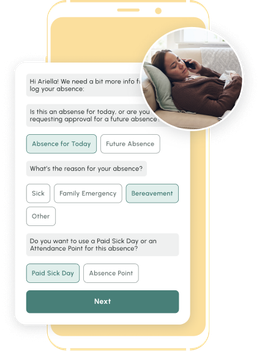
No one wants to talk to their boss or a 1-800 stranger to call off. Text changes everything - Reducing No Call No Shows.
Prevention and Mitigation Playbook (What to Do Before, During, and After an Absence)
You do not fix absence impact by hoping attendance improves. You fix it by building coverage and making the line easier to rebalance when reality hits.
Before the shift, focus on prevention basics. Balancing efficiency by optimizing staffing levels is crucial to prevent fatigue and safety issues, ensuring both productivity and employee well-being. Understaffing often requires employees to work additional hours originally allocated for personal needs such as rest, recovery, family time, social events, and personal responsibilities. Operations with lean staffing report significantly higher absenteeism rates compared to adequately staffed operations. Maintain a skill matrix and a cross-training plan aimed at constraint stations, not random rotation. Keep standard work current and build quick-reference aids so a trained backup can execute without hunting for answers. Plan floaters or relief roles for peak risk days, and make sure attendance policies connect to operational needs without turning into a legal debate.
During the shift, treat staffing like a live production variable. Real-time monitoring is essential to increase efficiency and improve overall efficiency by providing immediate visibility into staffing and production issues, allowing for proactive adjustments. Rebalance the line by reassigning tasks, re-sequencing work, and protecting the constraint station from getting pulled into side work. Adjust the production plan when you can, including running a different product, reducing changeovers, or prioritizing high runners that keep flow stable. Set clear escalation triggers so maintenance, QA, and supervision support gets pulled in early, not after the line is already buried, and use tools like automated employee call-in solutions so attendance changes are visible in real time.
After the shift, close the loop fast. Do a 24-hour review that answers which station failed first, what the first symptom was, and which decision made it worse. Update training priorities based on the coverage gaps that actually caused downtime. Then update standard work and the staffing plan so the next short-staff day is less painful.
Fatigued workers exhibit up to four times the workers' compensation costs compared to non-fatigued workers, and severe stress and fatigue can reduce worker productivity by up to 10%.
Role-Based Checklist: Supervisor, Manufacturing Engineer, HR/Workforce
Supervisors:
- Confirm coverage for critical stations before startup
- Verify cycle time and WIP behavior in the first hour
- Capture staffing-related reason codes in real time
- Identify the root cause of bottlenecks and use operational data to inform staffing decisions, ensuring the fastest possible response to skills gaps and minimizing line productivity loss
Manufacturing engineers:
- Identify single-point-of-failure operations and design backups
- Simplify handoffs and reduce walking for likely coverage scenarios
- Update line balance to reflect realistic staffing, not perfect staffing
- Leverage technology and KPI monitoring to maximize output and improve efficiency, enabling better response to demand shifts and enhanced resource utilization
HR and workforce managers:
- Track absence patterns at a practical level that supports scheduling
- Strengthen call-in timing and backfill process so coverage decisions happen sooner
- Coordinate training time allocation so cross-training is planned, not accidental
- Ensure integrated data systems are in place to support timely decision-making and help supervisors quickly fill skills gaps
Where call-in timing is a persistent gap, some teams use platforms like TeamSense to replace “call a manager” style reporting with a real-time, SMS-based call-off platform, or evaluate modern employee call-off hotline alternatives, so absence information reaches supervisors earlier and the backfill window is wider.
Final Thoughts
One absence is not just one headcount short. It is a system shock that can reduce throughput more than you would expect because it shifts the constraint, creates imbalance, and triggers downtime and quality disruption.
The best plants do not rely on heroics to recover. They build coverage on the stations that matter, keep standard work usable, and run a fast routine for rebalancing when a gap hits.
If you want a strong next step, audit constraint coverage with a skill matrix, tighten staffing-related downtime reason codes, and build a cross-training plan that starts where your line is most fragile. That is how you protect line productivity when the real world shows up at the time clock.
About the Author

Sheila Stafford, CEO & Co-Founder, TeamSense | Former Manufacturing Leader at GM, Whirlpool, and Fluke
Sheila Stafford is CEO and co-founder of TeamSense. Before launching TeamSense in 2020, she built her career inside manufacturing, starting as a manufacturing engineer at General Motors and later leading teams and product work at Whirlpool. She also served as a general manager at Fluke, where she led the Industrial Imaging business.
That background shapes how she writes about manufacturing operations, absenteeism, frontline communication, and workforce visibility. Stafford has worked close to plant operations, supply chain, product development, and the day-to-day realities of frontline teams. At TeamSense, she works directly with manufacturers on attendance and communication challenges, and her work has also appeared on Forbes Business Council.
