

Fix the root cause of No-Call No-Show with help from TeamSense
Table of Contents
- What the Manufacturing Labor Shortage Looks Like in Automotive
- How Absences Turn Into Throughput Loss
- The Operational Risks of Poor Assembly Line Staffing
- How Automotive Manufacturers Can Reduce Absence-Driven Throughput Loss
- Why Workforce Resilience Is Becoming a Competitive Advantage in Automotive
The manufacturing labor shortage in automotive is easy to misread if you only look at open requisitions. A plant can look staffed on paper and still lose output because the real problem shows up at the station, on the shift, at the exact moment a job has to be done. In a business built on sequence and timing, assembly line staffing is not just an HR issue. It is a throughput issue.
That matters even more now because the broader labor picture is still tight. Deloitte projects U.S. manufacturers may need 3.8 million workers between 2024 and 2033, and about 1.9 million of those jobs could go unfilled if workforce challenges continue. BLS also reported 311,000 manufacturing job openings in December 2025, which means many plants are already operating without much staffing buffer.
What the Manufacturing Labor Shortage Looks Like in Automotive
In automotive, a labor shortage does not mean one thing. It can mean open roles that stay unfilled for months, skilled jobs that are harder to cover than general production work, high employee turnover that keeps retraining the same positions, or same-day absences that blow up a shift plan before first break. Each one hits operations differently, but all of them affect output.
A manufacturing labor shortage in the automotive industry should be framed as an operating constraint, not just a headcount issue. Automotive plants depend on synchronized work across stamping, welding, paint, subassembly, final assembly, inspection, and material flow. When coverage breaks at one point, the problem rarely stays in one area.
The scale of the industry makes the exposure bigger. The United States produced 10,562,188 motor vehicles in 2024, which shows how much output depends on stable, repeatable labor coverage across high-volume operations. At the same time, more than 65% of respondents in NAM’s first-quarter 2024 outlook survey said attracting and retaining talent was their primary business challenge.
A plant can also be “fully staffed” in a misleading way. Headcount may match the budget, but that does not mean the right certified people are available on the right shift, on the right line, at the right stations. That gap between total headcount and true production-ready coverage is where assembly line staffing problems start costing real throughput.
Why Automotive Plants Feel Labor Gaps Faster Than Other Manufacturers
Automotive plants feel labor gaps faster because work is tied to takt time. If a station falls behind, the next station does not get more room to recover. The whole line starts absorbing delay.
Station dependency makes the problem worse. In a less sequential environment, one missing person may slow a local work area. In automotive, one missing operator at a constrained station can starve downstream work, create upstream pileups, or force supervisors to rebalance labor in real time.
Cross-training helps, but it has limits. Not every operator can step into a trim, torque-critical assembly, inspection, welding support, or specialized material handling without affecting cycle time or quality. Skill-specific work narrows your options fast.
The hours data points to how little slack many operations already have. In February 2026, production and nonsupervisory workers in motor vehicles and parts manufacturing averaged 43.9 weekly hours on a seasonally adjusted basis. When weekly hours are already high, there is less room to absorb one more staffing miss without a hit to output, fatigue, or both.
How Absences Turn Into Throughput Loss
Most throughput loss does not begin with a dramatic line stop. It starts with a call-off, a late arrival, or a no-show in a role that matters more than the raw headcount report suggests, because even one absence can cause line productivity loss that ripples across stations. Then the shift starts shuffling people to keep the line moving.
That shuffle has a cost. A cell runs short, a relief operator gets pulled, a team lead covers hands-on work instead of managing escalation, and cycle times stretch a few seconds at a time. The line may still run, but it runs below plan.
Normal absence rates are enough to create this pressure when hiring remains tight. In 2025, manufacturing recorded a 2.9% absence rate, while production occupations recorded a 3.4% absence rate. BLS also reported 13.759 million full-time wage and salary workers in manufacturing in that absence table, which shows how widespread the exposure is across the sector.
This is why throughput loss can happen without a shutdown. A line can keep running and still miss the shift target because labor gets reallocated, changeovers take longer, first-pass flow gets disrupted, and the operation spends the day recovering instead of producing illustrating how absenteeism impacts manufacturing productivity well beyond the immediate call-off.
The Costly Impact of Absenteeism on Manufacturing Operations
Learn how chronic, unplanned absenteeism is a costly impediment to manufacturing productivity and efficiency, and how you can reduce absenteeism.
The Hidden Multipliers Behind One Missed Shift
One absence rarely stays equal to one absence. The first impact is the uncovered job. The second impact is everything the plant has to do to compensate for it.
Remaining workers may get pushed into overtime, and in automotive, that matters because many teams are already working long weeks. When coverage depends on adding more overtime to an already stretched crew, the short-term fix can create next week’s absence problem.
Supervisors also get pulled off standard work. Instead of tracking flow, coaching, clearing material issues, or watching quality signals, they spend time filling holes, moving people, and deciding which risks to accept. That raises the odds of missed defects, rework, and schedule instability upstream and downstream.
Vacancies make the damage worse. If a plant is already carrying open roles, every absence lands on a system with less spare capacity. That is why a routine call-off becomes more disruptive when the plant has been hiring against 311,000 manufacturing job openings across the sector and cannot reliably backfill critical roles, and why unpredictable attendance in manufacturing becomes a core operational risk instead of a background HR issue
The Operational Risks of Poor Assembly Line Staffing
Poor assembly line staffing creates bottlenecks first, but it does not stop there. Once the line starts protecting one weak point, other parts of the operation begin trading off speed, quality, and labor stability.
One risk is unplanned downtime exposure. Deloitte cites research estimating that unplanned downtime costs industries about $50 billion annually. That figure is not a labor-specific measure, but it is a useful reminder that instability on the floor gets expensive fast when disruptions stack up.
Delivery risk follows close behind. Plants do not need a total stoppage to miss ship windows. A few soft hours of underperformance across multiple shifts can reduce completed units enough to create premium freight, schedule reshuffling, or customer pressure.
There is also a quality-and-safety angle. Fill-in coverage often means people working on unfamiliar tasks, rushing through awkward motions, or skipping the normal rhythm that keeps work under control. Even when the shift gets covered, the plant may pay later through rework, scrap, incident exposure, or burnout—exactly the kinds of outcomes tied to operational risk from unpredictable attendance.
Repeated reactive staffing can deepen the labor problem over time. If the answer is always overtime, constant shift changes, and daily firefighting, the job becomes harder to retain people in. That turns short-term coverage tactics into long-term workforce instability.
Why “Just Cover the Shift” Is Not a Real Staffing Strategy
“Just cover the shift” sounds practical, but it breaks down in real operations. Overtime can patch a gap, but it cannot create missing skills, restore lost institutional knowledge, or fix a weak staffing model.
Lean staffing becomes fragile when every absence requires heroics. If your plan assumes perfect attendance, unlimited flexibility, and experienced people always willing to stay late, it is not a plan. It is a bet.
Sustainable assembly line staffing requires visibility. Plants need to know where coverage is thin, which stations are hardest to backfill, and what happens to throughput when a role is uncovered for one hour, one shift, or one week something real-time shift-level attendance reporting is designed to make visible.
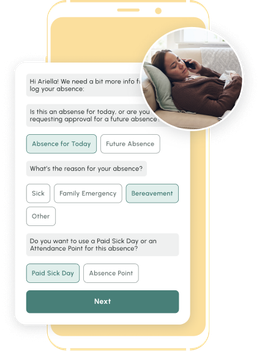
No one wants to talk to their boss or a 1-800 stranger to call off. Text changes everything - Reducing No Call No Shows.
How Automotive Manufacturers Can Reduce Absence-Driven Throughput Loss
The first step is to stop treating all roles the same. Cross-train around constraint points, not just around convenience. If one station consistently dictates line performance, build depth there first.
The second step is to create relief capacity on purpose. That can mean float pools, utility operators, or flexible coverage assigned by line risk and shift risk. In a thin labor market, not every plant can add headcount easily, but every plant can decide where a small amount of extra coverage protects the most throughput.
The third step is better attendance and staffing visibility. If unplanned absence patterns are rising by line, role, crew, or day of week, operations should see it early enough to adjust. BLS recorded a 2.9% absence rate for manufacturing in 2025, so monitoring absence trends is not optional background reporting. It is core operating data and a reason to invest in modern strategies to reduce absenteeism before it shows up as throughput loss.
Plants also need same-day escalation playbooks. Who gets called first? Which stations get priority coverage? What work can be delayed? What quality checks need extra attention when fill-ins are used? Standard responses reduce confusion when the day starts off short, especially when they are paired with streamlined, text-based call-off management instead of ad hoc phone trees.
Retention belongs in this section, too, because prevention beats reshuffling. If people keep leaving or calling off because schedules are unstable, overtime is constant, or communication is weak, the plant is training its own staffing volatility. Targeted efforts to reduce employee turnover in manufacturing become part of the throughput plan, not a separate HR initiative.
Metrics That Matter More Than Headcount Alone
Headcount alone does not tell you whether a line is protected. A better starting point is fill rate by critical role, especially for stations that control takt or quality, and shifting from simple headcount to skills-based coverage in manufacturing makes those metrics far more predictive.
Track unplanned absence rate by role, shift, and department. Pair that with overtime dependence, so you can see whether the plant is solving today’s shortages by borrowing from tomorrow’s capacity, and tie those metrics back to your shift coverage planning in manufacturing so schedule design reflects real risk.
Cross-training coverage is another useful metric. Count how many qualified backups exist for each production-critical role, not how many names appear on a roster. Then compare that to throughput variance by shift and first-pass yield under staffing strain.
Time-to-backfill matters too. A vacancy in a production-critical role is not just a recruiting metric. It is an operating risk window. When plants measure these numbers together, workforce planning starts connecting to output, delivery, and quality instead of sitting in a separate silo.
Why Workforce Resilience Is Becoming a Competitive Advantage in Automotive
Minimum coverage keeps a line moving on a good day. Workforce resilience keeps it performing on a hard day. That difference is becoming more important as the manufacturing labor shortage in automotive continues to put pressure on hiring, training, and retention, especially as U.S. auto manufacturing heads into 2026 with less margin for error.
Resilience means the plant can absorb routine variation without losing control of throughput. It means coverage plans are built around critical roles, absence patterns are visible, and supervisors are not rebuilding the shift from scratch every morning.
The plants that handle labor pressure best will not be the ones that simply post jobs faster. They will be the ones that treat workforce resilience as part of production strategy.
The automotive labor shortage is not abstract. It shows up in missed stations, slower cycles, extra overtime, rising quality risk, and shift targets that get harder to hit even when the line never fully stops. The real question for manufacturers is whether their current assembly line staffing approach gives them enough visibility, flexibility, and contingency coverage to protect throughput when the next absence hits.
About the Author

Jackie Jones, Content Strategist, TeamSense | Workforce Attendance & Frontline Operations
Jackie Jones is a content strategist at TeamSense, where she has spent the past four years working closely with CEO Sheila Stafford and the TeamSense team to cover the workforce issues that affect manufacturing operations every day. Her work focuses on attendance, absenteeism, shift coverage, frontline communication, supervisor workload, and the operational impact staffing instability has on productivity, overtime, safety, and downtime.
Through direct collaboration with manufacturing leaders and customer-facing teams, Jackie has built deep familiarity with how workforce challenges show up inside real plants and how companies respond when visibility is limited. She writes about frontline operations with a focus on practical problems, clear language, and the day-to-day realities supervisors, HR teams, and plant leaders are trying to solve.
