Fix the root cause of No-Call No-Show with help from TeamSense
An attendance management system tracks three things: presence, working hours, and time off. For hourly and frontline workforces, the part that decides whether the tool earns its keep is absence capture, which is knowing who is missing from a shift, why, and what happens next, before the shift starts.
One unplanned no-show can idle a production line, so how fast that absence reaches a supervisor is what protects your output and your labor budget.
This guide compares 10 attendance management software systems on the criteria that decide fit for an hourly workforce: Frontline accessibility, integration depth, absence management versus time tracking, points automation, and real-time supervisor visibility.
Some are built for absence capture, and others are time clocks or schedulers where absence is a side function. Each entry says which.
We evaluate 10 systems through the lens of an HR director managing hourly teams. You’ll find:
- An at-a-glance comparison table
- Individual reviews with features, best-fit buyers, and tradeoffs
- A feature-prioritization framework
- Evaluation questions for vendor calls
Cut no-show surprises before your next shift
TeamSense captures absences by text and pushes real-time headcount to supervisors before the line starts, with no app or company email required.
How We Evaluated These Systems
Each system below was assessed against those five criteria using vendor documentation, product and pricing pages, and published customer results, all checked in September 2026. Pricing changes often and tiers vary by headcount and billing term, so treat the figures here as a starting point and confirm on the vendor's own page before you shortlist.
At-a-Glance Comparison of Attendance Management Systems
Use this table for a fast side-by-side read before the detailed reviews below. It maps each system to the buyer it fits best, how workers interact with it, what it costs to start, and the single strength that sets it apart, so you can shortlist the two or three worth a closer look.
| Tool | Best For | Core Approach | Data Inputs | Key Strength | Starting Price |
|---|---|---|---|---|---|
| TeamSense | Deskless hourly workforces | Text/SMS-based absence reporting | Text, phone call, HRIS sync | No app required, HRIS integration | From $6,000/year |
| Truein | Multi-site contract workforces | Face-recognition biometric | Biometric, GPS, kiosk | AI-powered fraud prevention | From $0.58/user/mo + $40/mo base |
| Productivity Pilot | Call-off-heavy hourly operations | Multi-channel call-off hotline | Call, text, app, web portal | Omni-channel call-off capture | Not published |
| When I Work | Shift-based SMBs | Scheduling with time clocking | App clock-in, GPS | Fast scheduling and shift swaps | From $2.50/user/mo |
| Connecteam | Distributed deskless teams | All-in-one employee app | App clock-in, forms, GPS | Breadth of features in one app | Free to 10 users; paid from $29/mo |
| Zoho People | Growing companies on Zoho stack | HR suite with attendance module | Web, mobile, biometric API | Deep Zoho ecosystem integration | Paid plan required for attendance |
| Jibble | Budget-conscious SMBs | Face recognition and GPS tracking | Selfie, GPS, NFC, kiosk | Free tier with unlimited users | Free for unlimited users |
| Deputy | Compliance-sensitive industries | Scheduling with compliance engine | App, kiosk, POS | Fair workweek and break compliance | From $5/user/mo |
| Homebase | Small businesses with hourly staff | Free scheduling and time tracking | App, tablet kiosk, POS | Generous free plan | Free for 1 site, 10 staff; paid from $30/location/mo |
| actiPLANS | Teams focused on leave management | Lightweight leave and absence tracker | Web, mobile | Simple PTO tracking and accruals | Free to 3 users; from $1.50/user/mo |
The information in this table is current as of September, 2026
Best Attendance Management Software in 2026
The systems below span text-based absence management, app-based time tracking, scheduling-with-attendance, and PTO/leave management.
1. TeamSense
TeamSense is a text-based attendance management system built for hourly and frontline workforces. It sits on top of platforms like UKG, ADP, and Workday, filling the gap between an employee deciding to call off and that absence showing up in your system of record.
Selected Features
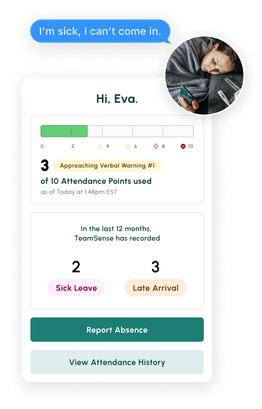
- Text-based absence reporting: Employees text a dedicated number to report an absence in roughly 15 seconds, with no app and no hold time. Workers without a smartphone can call in instead.
- Shift Start: Pre-shift headcount visibility so supervisors can adjust staffing before the line starts.
- Points System: Configurable attendance points that score recorded events against your policy and flag threshold breaches, with a protected-leave hold so HR reviews a possible FMLA situation before a point lands. The discipline decision stays with HR.
- Insights: Attendance analytics with threshold tracking and FMLA and ADA auto-filters applied to the underlying data.
- HRIS integrations: Syncs with UKG, ADP, Workday, Paycom, Paylocity, and BambooHR.
- Language support: Employees can report an absence in 150 languages.
- Communication: Broadcast messages and policy updates via text.
Best For
HR directors at mid-market manufacturers and deskless workforces. Especially strong for UKG and ADP users who need a complementary absence layer that works with their existing HRIS.
Real-Life Results
At a HelloFresh distribution center with more than 4,000 employees, managers had been spending three to four hours a day working through 300-plus voicemails. After moving call-offs to text, they reported a 30 to 50 percent reduction in the time spent managing attendance, finding shift replacements, and filling overtime.
Get pre-shift headcount visibility before the line starts
TeamSense layers text-based absence reporting and real-time supervisor alerts on top of your existing HRIS, with no app required.
2. Truein
Truein is a face-recognition attendance platform aimed at contract and multi-site workforces, using biometric verification to prevent buddy punching and time fraud.
Selected Features
- AI-powered facial recognition with anti-spoofing technology
- GPS geofencing restricting clock-ins to approved locations
- Offline-capable mobile and kiosk-based attendance capture
- 70+ customizable attendance policies and shift scheduling
- Integrations including Oracle Fusion, with ADP, SAP, and Paychex also listed by the vendor
Example Use Cases and Best For
Facility managers and construction firms managing dispersed contract workers across multiple job sites where identity confirmation is a hard requirement.
The Tradeoff
Truein verifies who was present and where. It doesn’t capture why someone is absent or route that to a supervisor before the shift starts, so if unplanned call-offs are your main problem it leaves that gap open. It runs on phones and tablets rather than dedicated hardware, so deployment is lighter than biometric systems usually imply.
3. Productivity Pilot
Productivity Pilot offers a multi-channel call-off hotline and attendance management platform supporting absences via phone call, text, app, or web portal. The vendor lists 150+ language support on its alerts and surveys.
Selected Features
- Multi-channel call-off capture (call, text, app, web)
- Automated points tracking and progressive discipline enforcement
- FMLA and PTO policy automation
- Mass communication tools for alerts and surveys
Example Use Cases and Best For
Operations leaders in manufacturing and distribution who need a dedicated call-off hotline with mature points automation.
The Tradeoff
Productivity Pilot is the closest tool on this list to a dedicated call-off platform, and it covers much of the same ground TeamSense does. The practical difference is channel strategy: it spreads reporting across four channels, where a text-first system keeps one path for everyone. Ask both vendors to demo the employee experience end to end, and to show the HRIS sync against your own system of record.
4. When I Work
When I Work is a scheduling-first platform with integrated time clocking for shift-based hourly teams. Its core job is building and filling rotating schedules, with a time clock and shift-swap tools layered on top. Employees can report an absence themselves within 24 hours of a shift, leaving a free-form note, and managers are notified so they can arrange cover. What it does not add is structured reason codes or a points workflow.
Selected Features
- Drag-and-drop shift scheduling with auto-scheduling
- GPS-enabled clock-in and clock-out
- Built-in team messaging without sharing personal numbers
- Labor forecasting and overtime tracking
Example Use Cases and Best For
Restaurant and retail managers needing fast scheduling and shift coverage.
The Tradeoff
Absence handling is built to get a shift covered rather than to enforce a policy. The reporting process on this is a free-form note, so there are no reason codes feeding call-off workflows or progressive discipline.
5. Connecteam
Connecteam is an all-in-one employee management app for deskless workers, combining operations, communication, and HR in a single mobile platform.
Selected Features
- AI-assisted scheduling and GPS-verified time clock
- Forms, checklists, and task management
- Team chat, broadcast updates, and knowledge base
- Free plan for up to 10 users, plus a kiosk station mode that lets several workers share one device
Example Use Cases and Best For
Multi-location field service operators and cleaning or security companies that want one app covering scheduling, communication, and HR.
The Tradeoff
Connecteam is app-first, which is an adoption question for frontline workers who would rather not install an employer app on a personal phone, though its kiosk station mode gives shared-device teams a way around that. Attendance sits inside a broad operations hub, so absence handling is one function among many rather than the core workflow.
6. Zoho People
Zoho People is a full HR suite with an attendance module and time-off management, suited to organizations already using the Zoho ecosystem.
Selected Features
- Attendance tracking with web, mobile, and biometric API integrations
- Leave management with customizable accrual policies
- Zia AI assistant for HR task automation
- Integration with Zoho Payroll, Zoho Recruit, and 800+ third-party apps
Example Use Cases and Best For
HR teams at growing companies that already use Zoho products and want a unified platform for attendance, leave, and core HR.
The Tradeoff
Attendance here is a module inside a full HR suite, which suits teams already standardized on Zoho. For an hourly frontline workforce, the gaps are text-based call-offs and real-time supervisor alerts before a shift. Attendance also sits outside the free plan.
7. Jibble
Jibble is a face-recognition and GPS-enabled time-tracking platform with a free-forever tier. It verifies identity and location at clock-in to stop buddy punching, and runs on phones, tablets, or a shared kiosk. The free plan covers unlimited users, which makes it popular with budget-conscious SMBs that mainly need proof of who showed up and where.
Selected Features
- Facial recognition and selfie verification to prevent buddy punching
- GPS and geofencing with location breadcrumb trails
- Shared kiosk mode for on-site clock-ins
- Integrations with Slack, Microsoft Teams, and QuickBooks
Example Use Cases and Best For
Small teams in construction and field services that need verified attendance without per-user cost.
The Tradeoff
Jibble answers who clocked in and where, which is a different question from who is missing and why. It does not capture structured call-off data, automate point-based attendance policies, or route absence notifications to supervisors.
8. Deputy
Deputy is a scheduling platform with a strong compliance engine for industries where labor law adherence is critical.
Selected Features
- AI-powered auto-scheduling with demand forecasting
- Fair workweek and break planning compliance tools
- Time clock with mobile app, kiosk, and POS integrations
- Shift swapping and open-shift posting
Example Use Cases and Best For
Hospitality and healthcare schedulers in jurisdictions with predictive scheduling laws or strict break regulations.
The Tradeoff
Deputy's depth is in scheduling compliance rather than absence management. Its published feature set centres on scheduling, time clocking, and labor-law compliance rather than call-off workflows, points automation, or absence analytics, so confirm those on a demo if they matter to you.
9. Homebase
Homebase is a free scheduling and time-tracking platform for small businesses with hourly workers. It bundles scheduling, a time clock, hiring, and team messaging into one tool aimed at single-location employers like restaurants, retail shops, and salons. A paid payroll add-on handles tax filing, and paid plans extend the product to multiple locations, billed per location.
Selected Features
- Free scheduling and time tracking for one location, up to 10 employees
- GPS and photo-verified clock-ins
- AI-assisted schedule builder
- Full-service payroll add-on with tax filing
Example Use Cases and Best For
Single-location small business owners, such as restaurants, retail shops, and salons, who want a free tool for scheduling and basic payroll.
The Tradeoff
Homebase's paid plans do support multiple locations, priced per location, so the real limit is depth rather than site count: there is no structured absence workflow behind the time clock. Manufacturers running a points policy will outgrow it.
10. actiPLANS
actiPLANS is a lightweight leave and absence tracking tool focused on PTO management, leave accruals, and team availability. It centers on planned time off: self-service requests, one-click approvals, and a visual timeline that flags scheduling conflicts across the team. Pricing starts low (a free tier for up to three users), which suits small HR teams that need leave visibility without a full workforce-management platform.
Selected Features
- Self-service leave requests with one-click manager approvals
- Unlimited leave types with customizable accrual rules
- Visual timeline for team availability and scheduling conflicts
- Free plan for up to three users; paid plans from $1.50 per user per month, dropping to $1.20 at 41 or more users
Example Use Cases and Best For
Small HR teams managing PTO requests and leave balances without a full workforce suite.
The Tradeoff
actiPLANS handles planned leave well but lacks real-time reporting for unplanned call-offs: no text or phone-based capture, no supervisor alerting, and no points automation.
Key Features and Capabilities to Prioritize in Attendance Management Systems
Not every feature carries equal weight for an hourly workforce. The capabilities below are the ones that separate a system your frontline teams will actually adopt from one that looks good in a demo and stalls at rollout. Weigh each against your own environment.
Frontline Accessibility
Deskless workers often have no company email and no regular computer access, so the interface has to be SMS, phone, or a browser page that works on any device. Gallup's Q12 meta-analysis, reports a 78 percent median difference in absenteeism between top-quartile and bottom-quartile engagement teams, which is a reason to weigh how reporting feels to the employee, not only how it records.
HRIS and Payroll Integration
Your HRIS is your system of record. An attendance management system should feed data into UKG, ADP, Workday, or whichever platform you run, not replace it. Look for bidirectional sync: roster changes flow in, absence data flows out.
Absence Management vs. Time Tracking
These are complementary but different functions. Time tracking answers "when did they clock in?" Absence management answers "who is missing and why?" Many platforms do one well and bolt the other on. Match the tool to your primary pain point, whether that is tracking absences or verifying presence, so you do not pay for features you do not need.
Points and Progressive Discipline Automation
Manual point tracking in spreadsheets creates inconsistency and legal exposure. Automated systems apply policies uniformly and flag FMLA-protected absences before points accrue, surfacing thresholds consistently so the discipline decision itself stays with HR. The Bureau of Labor Statistics publishes absence rates by occupation, which is useful for benchmarking your policies.
Real-Time Supervisor Visibility
A supervisor who learns about an absence two hours into a shift cannot adjust staffing. Pre-shift alerts, like TeamSense's Shift Start, give operations leaders time to reassign, call in backups, or adjust production targets.
Reporting and Benchmarking
Look for benchmarking against industry peers, trend analysis over time, and segmentation by location, shift, and reason code.
How to Choose an Attendance Management System for Your Team and Workflows
The right choice depends less on feature counts than on how you answer two sets of questions: one for your own team, one for every vendor you shortlist. Work through the two lists below before you sit through another demo.
Questions to Ask Internally
- Is our core problem unplanned absences, tardy arrivals, or shift coverage gaps?
- Do our frontline workers have smartphones, apps, or only basic phones?
- Does our HRIS already handle planned leave, or do we need that covered too?
- Who needs to be notified first when someone calls off: HR, the supervisor, or both?
Questions to Ask Vendors
- How does your system integrate with our specific HRIS (UKG, ADP, Workday)?
- What does the employee experience look like for reporting an absence? How many steps?
- Can the system differentiate between FMLA-protected and disciplinary absences automatically?
- What does onboarding look like for a workforce that does not use email or apps?
See how text-based absence reporting works for your workforce
TeamSense gives supervisors pre-shift headcount visibility and feeds absence data directly into your HRIS, with no app required.
FAQs About Attendance Management Systems
-
Time tracking records clock-in and clock-out times to calculate hours worked. Attendance management captures and routes absence data: who is missing, why, and what policy applies. Most organizations need both, but they solve different problems.
-
Most modern systems integrate with major HRIS and payroll platforms. Depth varies. Some offer one-way data export, while others support bidirectional sync with UKG, ADP, Workday, and similar systems. Ask vendors to demonstrate the specific integration with your platform.
-
Points systems assign numerical values to absence types, such as one point for a late arrival and three for a no-call, no-show. Points accumulate on a rolling window, typically 12 months, and trigger progressive discipline at set thresholds. Automated systems apply rules uniformly and flag protected absences for review before a point lands, leaving the discipline decision with HR.
-
Yes, though the detail matters. Text-based systems avoid an app download, but the text usually returns a link to a web page, so the worker still needs a data connection. For workers without a smartphone, the fallback is a phone call-in line, which may be offered in fewer languages than the text path. Ask vendors to walk you through both routes.
-
Jibble's free tier covers unlimited users with facial-recognition and GPS clock-in, which makes it the broadest free option here. Homebase is free for one location with up to 10 employees, and Connecteam is free for up to 10 users across all its hubs. All three are time-clock or scheduling tools first, so none of them replaces a structured absence workflow.
-
Deputy and When I Work are the two strongest schedulers here. Deputy leans into labor-law compliance, with fair workweek and break planning tools, which suits hospitality and healthcare in regulated jurisdictions. When I Work is quicker to set up for straightforward shift building and swaps. Neither captures absences with reason codes or runs points automation.
-
Prioritize real-time supervisor notifications, HRIS integration depth, text or phone-based accessibility, points automation with FMLA safeguards, and benchmarking data. Manufacturing needs tools that work before the shift starts, not tools that record what happened after.
Helpful resources

Absence Check Alternatives: 6 Call-Off Tools Beyond the $1 Option
Compare six Absence Check alternatives on pricing, points visibility, HRIS depth, and adoption on the floor, with published rates checked October 2026.

Continental Message Solution Alternatives: 6 Call-Off Tools Compared
Compare six Continental Message Solution alternatives for hourly call-off reporting, with pricing, HRIS depth, points handling, and the limits of each.

Best Employee Communication Apps for Frontline Teams [2026]
Compare seven employee communication app options for frontline and deskless teams, with verified features, pricing, and a tradeoff for each.
Is your call-in process terrible? Text reduces no-shows and absenteeism by up to 40%.
Don't believe us? Check out this case study to see how this 3PL benefited.