
Fix the root cause of No-Call No-Show with help from TeamSense
Table of Contents
- Why tax season puts old attendance mistakes under more pressure
- Why shift-based employers are more exposed
- What weak attendance records look like in practice
- How small breakdowns become bigger payroll problems
- What happens once bad attendance data reaches payroll
- The companies that avoid spring payroll scrambles usually fix the process earlier
- How employers can get ahead of this before next tax season
As employees review W-2s ahead of the April 15 filing deadline, companies with messy attendance records may be forced to reconstruct payroll history under pressure. What looks like a small timekeeping miss in June of last year can become a much bigger problem by spring if call-offs, shift swaps, missed punches, or manual edits were never documented cleanly in the first place.
For shift-based employers, that risk is higher because attendance data often changes in real time and passes through multiple hands before it reaches payroll. By the time someone notices a wage discrepancy, the business is no longer fixing a simple exception. It is trying to rebuild a record trail on deadline.
For the 2025 tax year, the federal individual filing deadline is April 15, 2026. Employers generally had to furnish 2025 Forms W-2 to employees by February 2, 2026, because the usual January 31 deadline fell on a weekend. That creates a narrow window for employers to respond when workers begin questioning year-end wage records during filing season.
The problem often begins long before anyone is looking at a tax form. A missed punch may have been patched with a manual edit. A call-off may have been left on voicemail but never entered cleanly into the system of record. A shift swap may have been handled on the floor without a clear audit trail. Those kinds of gaps can sit quietly inside payroll history until tax season turns them into something more urgent.
Why tax season puts old attendance mistakes under more pressure
Attendance errors often do not trigger an immediate crisis. If an employee’s pay looks close enough to expected, or if a supervisor makes a quick adjustment that appears to resolve the issue, the record can move forward without drawing much attention. By the time the pay period closes, the exception may look settled even if the underlying documentation is weak.
Tax season changes that level of scrutiny. Employees start reviewing totals, withholding, and year-end wage figures more closely because they need confidence before filing a return. Questions that might have gone unasked during the year become harder to ignore when the numbers on a W-2 do not match what the worker believes they earned.
IRS guidance says that if a missing or corrected W-2 has still not been resolved by the end of February, employees can contact the agency for help. The IRS says it will contact the employer and, in cases involving a corrected W-2, request that the employer furnish the corrected form within 10 days. The agency also says workers may need to use Form 4852 if a corrected W-2 does not arrive in time to file, which can delay refund processing while the information is verified.
That means a recordkeeping issue that may have started months earlier can suddenly affect filing timelines, employee confidence, and the employer’s need to respond quickly under outside pressure.
Why shift-based employers are more exposed
The risk is not spread evenly across all employers. Shift-based operations tend to have more attendance volatility, more schedule changes, and more handoffs between the floor and payroll. Schedules change midweek. Employees trade shifts. Overtime shows up late. Break exceptions are handled after the fact. Leads and supervisors make judgment calls in real time. Each of those moments creates another opportunity for the official pay record to drift from what actually happened on the floor.
That matters because hourly work remains a major part of the U.S. labor market. In 2024, 80.3 million U.S. workers age 16 and older were paid hourly, representing 55.6% of all wage and salary workers.
The Department of Labor also says employers covered by the Fair Labor Standards Act must keep records that include hours worked each day, total hours worked each workweek, basis of pay, regular hourly rate, straight-time earnings, overtime earnings, and additions to or deductions from wages.
In other words, this is not a narrow payroll edge case. It is a recordkeeping exposure built into the way many shift-based businesses operate.
What weak attendance records look like in practice
In practice, attendance rarely unfolds in a clean, linear way. Someone clocks in early because production is already moving. Someone stays late because the relief arrives behind schedule. A worker covers another station, works a split shift, or crosses into overtime after a last-minute absence changes the lineup.
Those are normal operating conditions in industries like manufacturing, retail, hospitality, healthcare, and field services. The problem is not that exceptions happen. The problem is that exceptions happen constantly, while the process for documenting them may still rely on scattered communication and inconsistent follow-through rather than a consistent attendance-tracking system.
Once that happens, the business relies less on a single record of what occurred and more on whatever details survive from paper notes, verbal updates, or memory, rather than using more modern employee communication tools that keep information centralized and traceable.
One supervisor may receive a call-off on voicemail. Another may jot down a shift change on paper. Payroll may get only part of the update days later and have to infer whether the employee missed the entire shift, swapped with someone else, or made up the time later in the week.
That kind of breakdown is larger than a simple missed punch. It is a communication design problem between the floor and payroll. The Department of Labor’s FLSA recordkeeping guidance says employers must maintain the records used to compute pay, which underscores a basic point: payroll accuracy depends on records that are accurate, retained, and accessible, not scattered across side channels.
When attendance information moves through too many informal steps, the risk is not just that payroll will be slow to fix an error. It is possible that the business may no longer have a reliable way to prove what happened.
The Costly Impact of Absenteeism on Manufacturing Operations
Learn how chronic, unplanned absenteeism is a costly impediment to manufacturing productivity and efficiency, and how you can reduce absenteeism.
How small breakdowns become bigger payroll problems
Most payroll rework tied to attendance does not stem from a single dramatic failure. It comes from routine breakdowns that accumulate across the year: missed clock-ins, missed clock-outs, off-system call-offs, unapproved edits, paper-based shift notes, delayed corrections, and supervisor-to-payroll lag.
Any one of those may look manageable in isolation. In aggregate, they increase the odds that payroll is working from incomplete or low-confidence inputs.
Retroactive edits create their own problems when entered from memory rather than from documentation. A supervisor may recall that an employee stayed late, left early, covered another role, or missed part of a shift. But if that change is entered days later without a clear record, the correction may introduce another layer of uncertainty.
That gets more complicated when approvals lag or when overtime is involved. A small issue in one pay period can ripple into later calculations if it is not resolved promptly and well documented. By year-end, the W-2 reflects the quality of the correction process that happened all year, not just the work that was actually performed.
What happens once bad attendance data reaches payroll
Once weak attendance records are entered into payroll, the consequences extend beyond a single discrepancy. What began as a shift-level issue can turn into employee complaints, supervisor follow-up, HR investigation, payroll rework, and, in some cases, corrected forms.
That creates a rush of administrative work at exactly the point in the year when employees want straightforward answers, and payroll teams are already dealing with time-sensitive reporting.
There is also a broader reminder here about how costly wage-record failures can become. In fiscal year 2025, the U.S. Department of Labor recovered more than $259 million in back wages for nearly 177,000 employees nationwide. That figure is not specific to attendance communication, but it shows the scale of wage and payroll compliance problems employers still face.
The pressure, then, is not just about correcting a document. It is about reconstructing enough of the attendance and pay history to support the correction in the first place.
The companies that avoid spring payroll scrambles usually fix the process earlier
The companies least likely to face these problems in March and April are usually the ones that treated attendance communication as part of payroll control long before W-2 season arrived. They are less dependent on side-channel communication, less reliant on memory, and more likely to move attendance exceptions through a standard process before each pay run closes.
That generally means centralizing call-offs and attendance exceptions into one approved channel, creating clearer approval deadlines, and requiring documentation standards for time edits. It also means reviewing unresolved punches, retroactive changes, and missing approvals before year-end wage reporting turns those gaps into something harder to manage.
The Department of Labor’s recordkeeping requirements make clear that accurate pay depends on accurate records. Tax season simply makes that reality harder to ignore.
For employers dealing with last-minute call-offs, missed punches, and supervisor-to-payroll lag, that kind of upstream control usually starts with how attendance communication is captured in the first place. If absences are still being reported across voicemails, paper notes, and hallway conversations, the business is making payroll work harder than it should.
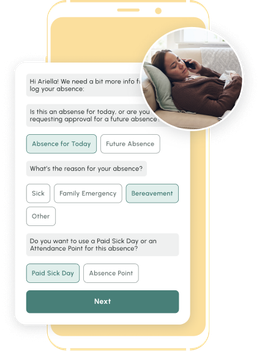
No one wants to talk to their boss or a 1-800 stranger to call off. Text changes everything - Reducing No Call No Shows.
How employers can get ahead of this before next tax season
The easiest time to fix a W-2 problem is before it becomes one. For shift-based employers, that usually means tightening the process around attendance communication long before year-end reporting starts.
That starts with making call-offs easier to capture in one place. When absences come in through scattered voicemails, and verbal updates, supervisors and payroll are left piecing together what happened after the fact. A more consistent system gives teams one record of who called off, when it was reported, and what follow-up happened next.
It also helps to reduce the lag between the floor and payroll. When attendance updates move quickly from employees to supervisors and into a documented workflow, there is less need for retroactive edits, less dependence on memory, and less risk that a routine exception turns into a payroll discrepancy months later.
That is where tools like TeamSense fit. TeamSense helps manufacturers and other shift-based employers centralize call-offs and attendance communication in one place, giving supervisors and HR a clearer data record to work from before payroll issues pile up. Instead of relying on side-channel communication, teams have a more consistent way to document absences, spot exceptions earlier, and reduce the kind of record gaps that become harder to fix during W-2 season.
For companies that feel like they are always cleaning up attendance issues after the fact, the bigger opportunity is to fix the communication process upstream. Tax season just makes those gaps easier to see.
By the time employees begin questioning wage totals on a W-2, the cost of weak attendance communication is no longer theoretical. The business is not just cleaning up timecards. It is trying to rebuild a record trail as the filing deadline approaches.
